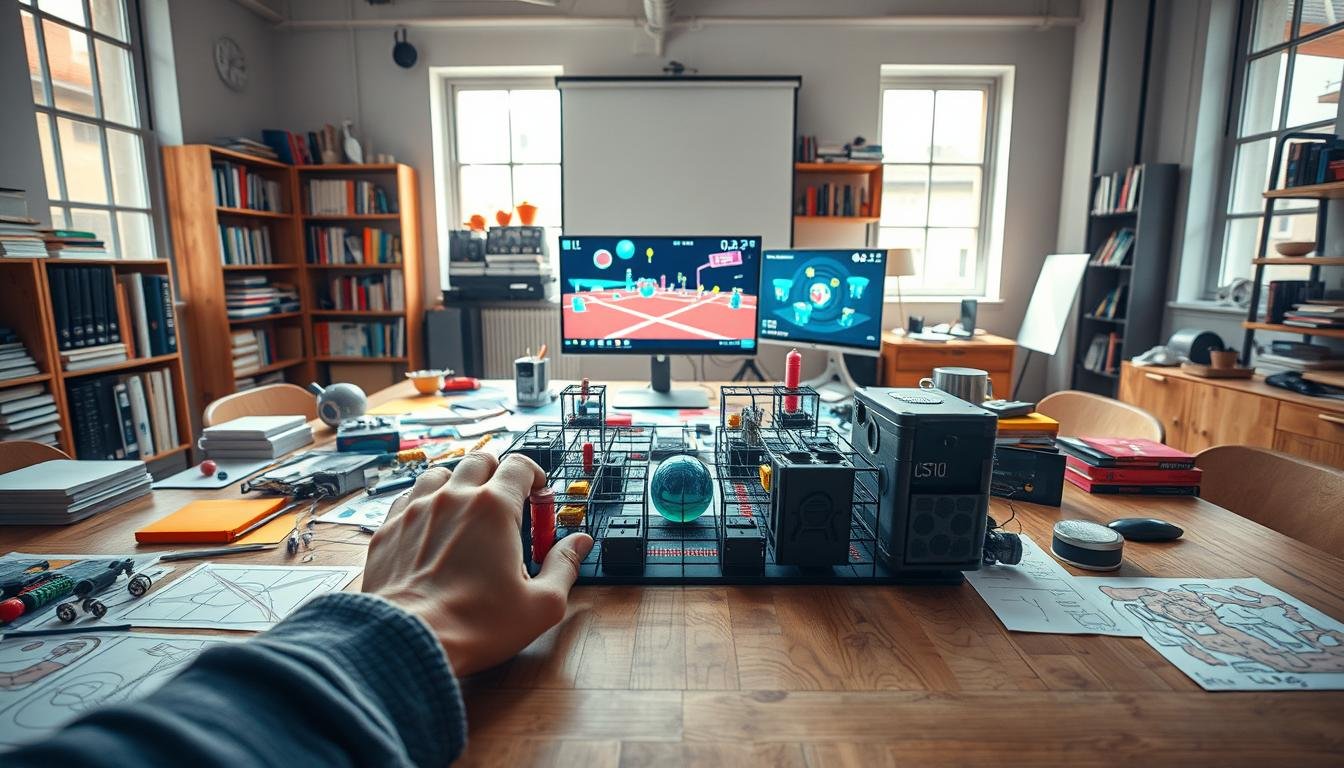
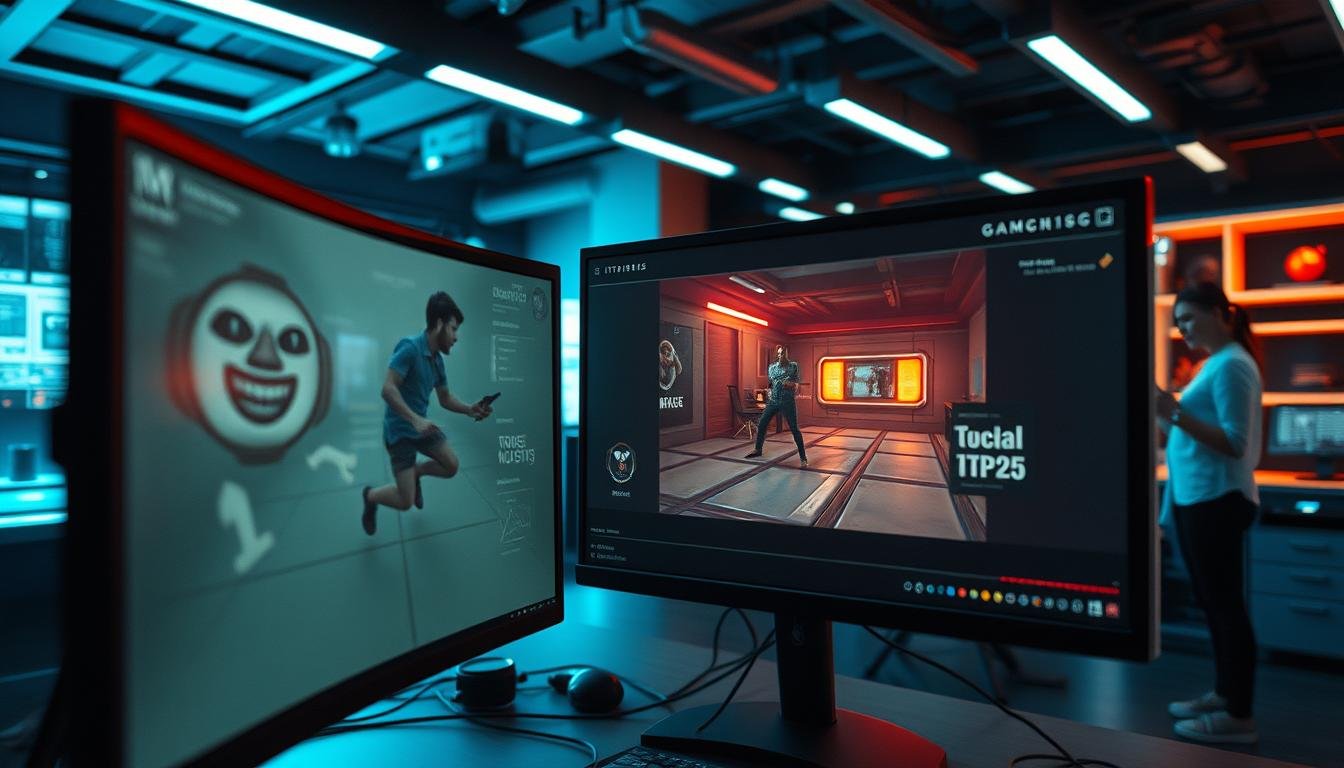
Creating intelligent opponents in video games transforms simple encounters into dynamic challenges. This guide helps developers build non-player characters that react intelligently to user actions. You’ll learn practical techniques for crafting believable behaviors that enhance player engagement.
The gaming industry increasingly demands accessible resources for intelligent character development. This tutorial bridges the gap between theoretical concepts and real-world implementation. You’ll gain hands-on experience with systems that respond dynamically to player movements and decisions.
Whether working on independent projects or learning foundational skills, these methods apply directly to development work. The approach emphasizes practical problem-solving over abstract theory. You’ll discover how to transform scripted actions into sophisticated decision-making systems.
Professional developers use these industry-standard techniques across various genres. Following this structured methodology, you’ll create opponents that track users, make tactical choices, and generate memorable gameplay moments. The focus remains on immediately applicable solutions that deliver results.
Key Takeaways
- Learn to create responsive non-player characters that react to user actions
- Bridge the gap between AI theory and practical game development
- Implement dynamic behaviors that enhance player engagement
- Apply industry-standard techniques across multiple game genres
- Transform simple scripts into sophisticated decision-making systems
- Focus on practical implementation over abstract concepts
- Create memorable gameplay experiences through intelligent opponent design
Introduction and Overview
Crafting believable computer-controlled adversaries turns routine gameplay into memorable encounters. This tutorial provides a structured path from foundational concepts to functional implementation.
Purpose of the Tutorial
Our goal is to simplify character behavior development through clear, practical guidance. You’ll learn how predetermined response systems create engaging experiences.
This approach focuses on creating the illusion of intelligence through well-designed rules. The emphasis remains on enhancing player experience rather than complex reasoning.
What to Expect in This Guide
You’ll gain hands-on experience with coding exercises and conceptual explanations. Real-world examples from successful video games illustrate effective design patterns.
By completion, you’ll build a working system demonstrating core behaviors. These include detection, pursuit, and tactical decision-making.
The methodology emphasizes practical implementation over theoretical complexity. You’ll understand that compelling behavior stems from clever design rather than processing power.
Getting Started with a Basic Enemy AI Prototype
Effective computer-controlled opponents start with well-organized project architecture. This initial phase establishes the framework for all subsequent behavior development. You’ll create systems that detect user presence and respond appropriately.
Begin by defining clear objectives for your character’s actions. Determine how it should react when spotting the player and what limitations maintain balanced gameplay. Modular code structure enables easy testing and future expansion across different scenarios.
The initial system focuses on core functionality like target tracking and simple responses. This minimal approach allows for rapid iteration based on actual gameplay feedback. Testing reveals what works and what needs adjustment.
Understanding how game state connects to perception and action forms the foundation for sophisticated behaviors. This architectural planning ensures smooth integration of advanced features later. Your organized start sets the stage for complex opponent development.
Fundamentals of Game AI and NPC Behavior
Game developers achieve believable character interactions through systematic approaches to behavioral programming. This foundation separates memorable gaming experiences from routine encounters.
Understanding Enemy AI Principles
Video game intelligence focuses on creating the illusion of smart behaviors rather than actual reasoning. These systems respond to game state changes with predetermined rules.
The goal is entertaining interactions that feel authentic to players. Well-designed opponents appear to think strategically while following programmed patterns.
The Role of RayCast3Ds in NPC Vision
RayCast3Ds function as virtual eyes for non-player characters in 3D environments. They cast invisible lines toward potential targets to check for direct visibility.
When these detection rays hit players without obstruction, enemies transition to combat states. This system ensures opponents only react to visible threats.
Early video games used stored movement patterns before microprocessors enabled dynamic behaviors. Landmark titles like Pac-Man demonstrated how distinct personalities create engaging challenges.
Designing Enemy Combat States and Engagement
Well-defined engagement states create meaningful tactical encounters between players and opponents. These behavioral phases determine how computer-controlled characters respond to user presence and threats.
Clear state design ensures opponents react appropriately to different situations. This creates dynamic gameplay that feels responsive and challenging.
Transitioning from Idle to Combat
The shift from passive to aggressive behavior represents a critical gameplay moment. Detection systems trigger this transition when opponents spot the player.
RayCast3D visibility checks confirm direct line-of-sight to the target. This confirmation initiates the combat sequence rather than instant aggression.
Gradual escalation allows for investigation behaviors before full engagement. Players receive warning signs and tactical opportunities to respond.
Calculating Ballistic Solutions
Accurate firing requires mathematical trajectory computations for projectiles. The system predicts where the target will be when the shot arrives.
Factors include target position, projectile velocity, and gravity effects. These calculations determine the precise aim angle needed.
Turret rotation aligns with the computed solution before firing. The system waits until the angular difference falls below an accuracy threshold.
Timing considerations create rhythmic combat rather than continuous firing. This gives players windows for tactical action and movement.
Implementing Location-Dependent Damage and Hit-Boxes
Implementing zone-specific damage multipliers transforms simple hit detection into tactical combat scenarios. This approach rewards strategic positioning and precise targeting during engagements.
Simulating Armor Through Impact Zones
The system divides vehicle models into distinct impact regions. Each zone receives different damage multipliers reflecting armor strength.
Mathematical calculations determine hit location by comparing angles. The system measures the XZ angle between the vehicle’s center point and impact position.
This calculation classifies strikes as front, side, or back impacts. Front armor provides maximum protection with damage reduction to 5-25% of base values.
Side impacts deliver moderate damage ranging from 25-50%. This balance rewards flanking maneuvers without making them decisive.
Rear strikes inflict maximum damage at 50-100%. This represents vulnerable components and thinner rear armor plating.
The hit-box system creates emergent tactical gameplay. Both players and computer-controlled characters must consider positioning and angle of approach.
Integrating Radio Communication Among NPCs
Implementing radio communication systems elevates non-player character interactions from isolated encounters to coordinated group tactics. This approach transforms individual combat units into cohesive teams that respond collectively to battlefield developments.
The system creates realistic information sharing where vehicles alert nearby allies when detecting threats or taking damage. This broadcast capability prevents unrealistic instant awareness across large maps.
Locality and Signal Broadcasting Techniques
Radio communication relies on Area3D nodes to define transmission and reception ranges. Each vehicle contains spherical RadioTxRange and RadioRxRange areas on a dedicated collision layer.
When specific events trigger communication needs, the system emits signals to parent vehicles with overlapping reception ranges. Team affiliation filtering ensures messages only reach allied units, maintaining clear faction boundaries.
This architecture creates emergent tactical situations where user actions have cascading consequences. Engaging one target may alert multiple nearby vehicles, encouraging strategic approaches to combat scenarios.
The communication system balances realism with gameplay needs through controlled broadcast ranges. Players must consider radio networks when planning their tactical moves across different areas.
Mapping Trials and Terrain Modeling in Blender
Terrain modeling marks a critical transition from conceptual design to tangible game world creation. This phase moves development beyond placeholder geometry into professionally crafted environments. The process tests workflows for exporting assets from modeling software into the game engine.
Blender provides powerful sculpting tools for creating realistic landscape features. Developers can craft rolling hills, valleys, and ridges that would challenge in-engine terrain generators. This external modeling approach offers greater control over topographical variations.
Creating and Importing Terrain into Godot
The workflow began with establishing dimensions based on gameplay needs. A tile-based approach used individual 2km x 2km sections that could connect seamlessly. This modular design allowed for expanding the play area to 6km x 6km total.
Edge tapering techniques ensured smooth connections between tiles. Perimeter points gradually reduced elevation to zero at boundaries. This prevented visible seams and navigation issues when adjoining flat transitional tiles.
Importing models into Godot required careful export settings from Blender. Proper scale, orientation, and mesh topology preservation was essential. The engine then generated collision maps for ground surface interactions.
The mapping experiment populated terrain with buildings and vehicles to test scale relationships. This revealed important insights about travel times and visibility ranges. Hills created tactical advantage points where targets gradually revealed themselves as players crested elevations.
Long-distance combat testing proved particularly valuable. Successfully calculating shots at barely-visible distant targets delivered satisfying gameplay moments. These trials established art pipeline workflows for all subsequent level creation.
Constructing a Dynamic Game Environment
Dynamic level design begins with simple geometric forms that establish the foundation for complex gameplay interactions. This methodical approach ensures functional requirements receive priority before visual refinement.
Developers start with primitive shapes like cubes and cylinders during early testing phases. These basic forms load quickly and allow focus on core mechanics without detailed asset overhead.
Using Primitive Shapes to Detailed 3D Models
The iterative process maintains consistent scale and collision properties throughout visual upgrades. This prevents breaking established mechanics during aesthetic improvements.
Environmental variety creates diverse combat scenarios across different map regions. Dense urban areas with narrow streets present different challenges than open terrain.
Level construction incorporates visual landmarks that aid player navigation. These distinctive features serve both functional and memorable purposes throughout the experience.
The final environment supports emergent gameplay through interactive elements and varied terrain. Both players and computer-controlled characters adapt tactics based on surrounding features.
Building New Tank Models and AI Driving Mechanics
Developing autonomous vehicle navigation requires careful integration of 3D modeling and pathfinding systems. This phase moves beyond static assets to create moving entities that interact intelligently with their environment.
The process began with comprehensive 3D modeling work for new combat vehicles. Each model featured separate components for chassis, turret, barrel, and tracks. These elements could be animated and controlled independently during gameplay.
Navigation Regions and Mesh Integration
NavigationRegion3D nodes established the framework for autonomous movement through game environments. These regions defined traversable areas where vehicles could legally drive. The system calculated valid routes between any two positions within navigable space.
Navigation mesh generation proved more efficient with basic geometry. The development temporarily returned to primitive-based level design for testing purposes. This approach simplified the pathfinding implementation during early stages.
The driving mechanics enabled computer-controlled vehicles to process navigation data autonomously. They calculated routes to objectives and issued control inputs for steering and acceleration. Waypoint following systems broke long routes into sequential target points.
Each vehicle focused on reaching its immediate waypoint by calculating required steering angles. Throttle inputs maintained appropriate speed while moving toward destinations. Complex behaviors handled collision avoidance and graceful slowing before sharp turns.
Enhancing Collision Avoidance and Waypoint Navigation
Modern collision detection represents a quantum leap forward from earlier navigation approaches that struggled with group movement. Contemporary systems prevent traffic jams among multiple units through sophisticated scanning techniques.
Leveraging ShapeCast3D Against Obstacles
ShapeCast3D technology provides comprehensive spatial awareness by casting volumetric shapes ahead of vehicles. This method detects obstacles across the entire width of the movement path.
The system offers significant advantages over managing arrays of individual detection rays. Implementation becomes simpler while improving coverage across complex environments.
Waypoint navigation guides vehicles through sequential target points along predetermined routes. Each navigation point represents a position the vehicle should pass through.
Precision must balance with natural-looking movement. Requiring exact coordinate matching creates stuttering behavior. Generous arrival tolerances produce smoother motion that feels more realistic.
Dynamic obstacle detection handles moving threats that weren’t present during initial path calculation. The system maintains planned routes while making real-time adjustments to avoid collisions.
Response strategies vary based on obstacle proximity. Distant threats trigger gradual steering changes. Suddenly appearing obstacles may require emergency maneuvers to prevent impact.
Advanced AI Navigation in Large-Scale Environments
Scaling navigation systems to accommodate vast game worlds presents unique computational challenges that traditional pathfinding methods struggle to address. The “Nine Hills” testing environment measured 12km x 12km, created from nine individual 4km x 4km terrain tiles arranged in a grid pattern.
This expansive play area enabled testing of long-range engagements and complex movement patterns. Navigation region merging techniques proved essential for creating seamless travel across tile boundaries.
Terrain topology significantly influenced route calculation and visibility. Rolling hills created natural cover and strategic vantage points that affected both player tactics and computer-controlled movement decisions.
Level of detail systems became critical for maintaining performance across such large spaces. Distant objects rendered with simplified geometry while preserving visual quality for nearby elements.
The scale allowed for emergent gameplay scenarios impossible in smaller maps. Multi-vehicle coordination and long-distance pursuits tested the navigation system’s robustness under realistic conditions.
Performance optimization strategies included distance-based update frequency reduction. Characters far from player interaction received simplified decision-making to conserve processing resources.
Optimizing Enemy AI Movement and Interaction
Fine-tuning how computer-controlled characters move and react is crucial for creating immersive and challenging game experiences. This process involves careful calibration to ensure opponents feel intelligent and responsive without overburdening system resources.
The goal is to achieve a perfect harmony between technical performance and engaging behavior.
Balancing Precision and In-Game Realism
Movement systems must feel appropriate for the game’s genre. Tactical scenarios often demand precise positioning. Fast-paced action benefits from quicker, more responsive motions.
Realism in this context means creating believable behaviors, not perfect physics simulations. Overly precise movements can appear robotic. Excessively loose controls might feel unfair to the player.
Smooth, consistent motion significantly impacts the player’s perception of quality. Stuttering or delayed reactions can make even sophisticated logic seem poor. Time-based calculations prevent behavior changes across different hardware.
Every interaction system requires individual tuning. Targeting, shooting, and communication all affect the final gameplay feel. Iterative testing with real sessions is essential for discovering optimal settings.
This reveals how multiple systems interact with user actions. The result is a balanced and enjoyable experience for everyone.
Sound and Animation: Bringing AI to Life
Audiovisual elements transform mechanical character behaviors into memorable combat encounters. These components provide crucial feedback about opponent actions through carefully crafted visual and auditory signals.
Attack sequences communicate offensive actions through character movement and visual flourishes. Inspired by Final Fantasy VI’s Blitz techniques, a multi-stage approach creates dramatic presentations.
Deploying Attack Animations and Sweeping Sound Effects
The sequence begins with opacity reduction to 25% during initial approach movements. After a 30-frame wait, the battle interface disappears to focus player attention.
Characters then execute rapid position changes across four target zones. Each movement lasts five frames with accompanying animation and sound.
Precise timing ensures consistent presentation across different hardware. Frame waits prevent sequence compression that would make actions too fast to appreciate.
Opacity gradually returns to 100% over 30 frames as characters reset to home positions. The interface reappears once normal gameplay resumes.
This structured approach makes individual strikes feel significant and powerful. Players receive clear information about combat flow through these audiovisual cues.
Adapting Industry Inspirations into Your Prototype
Studying successful game mechanics from established titles provides a powerful shortcut for developing compelling character behaviors. This approach reduces risk by building on systems that have already demonstrated player appeal.
The key is to understand the core principles behind an effective system, not just copy its surface details. This thoughtful adaptation process ensures borrowed concepts genuinely enhance your specific project.
Insights from Final Fantasy VI and Tank Game Developments
Final Fantasy VI’s Blitz techniques offer a brilliant example of transforming simple actions into memorable events. The multi-stage animation with dramatic timing makes each skill feel impactful.
This principle of creating distinctive, well-paced attack patterns translates across many video game genres. It shows how presentation elevates gameplay.
The tank game project illustrates the integration of complex systems like ballistic targeting and location-based damage. These elements work together to create believable opponents.
Players face challenges that reward strategic positioning and skill. Targets react intelligently, creating a cohesive and engaging experience.
Learning from these examples helps developers create fair but challenging opponents. The goal is to build systems that feel rewarding to master.
Testing and Tweaking AI Parameters
The refinement phase transforms functional character systems into polished gameplay experiences through careful parameter adjustment. This process ensures opponents respond appropriately to user actions while maintaining balanced challenge levels.
Developers need clear visibility into decision-making processes during this stage. Visualization tools display perception ranges and pathfinding routes directly within the game view.
Debugging States and Fine-Tuning Behavior
Parameter tuning identifies numerical values controlling detection ranges and reaction times. Systematic adjustment finds configurations that produce desired gameplay characteristics.
The iterative testing process requires extensive play sessions with different configurations. Documentation tracks how each change affects difficulty balance and player experience.
Common issues include characters that are too passive or aggressive. Pathfinding problems can create awkward movement patterns that break immersion.
Code instrumentation with logging systems records decisions and state changes during gameplay. This data reveals patterns in problematic behaviors that might escape live observation.
Fine-tuning seeks the balance point where challenge feels appropriate without frustration. Multiple test iterations with representative users help calibrate systems correctly.
Documentation of final parameter values maintains consistent behavior during future development. This prevents accidental regression of carefully tuned systems.
Conclusion
Mastering non-player character interactions requires balancing technical precision with engaging gameplay experiences that resonate with users. This journey demonstrates that compelling opponents emerge from thoughtful system integration and extensive playtesting rather than complex theoretical approaches.
Developers completing this guide gain practical skills in perception systems, behavioral logic, and combat mechanics. These techniques form a versatile foundation applicable across various game genres and future projects. The knowledge transfers well to different character types and complexity levels.
Successful development balances computational efficiency with sophisticated behaviors. Continue experimenting with parameter adjustments and testing edge cases. The gaming community offers abundant resources for expanding these foundational skills into unique creative ventures.
FAQ
What is the primary goal of creating a basic enemy AI prototype?
How does RayCast3D contribute to an NPC’s ability to "see" the player?
What are hit-boxes and how do they affect damage calculation?
Can NPCs communicate with each other in this system?
What role does terrain modeling play in AI navigation?
How are animations and sound effects integrated into AI behavior?
What is the purpose of fine-tuning AI parameters during testing?

Game developer with over 10 years of professional experience specializing in the mobile sector. George’s journey began with a passion for indie development, leading him to contribute to several successful mobile titles, including the critically acclaimed puzzle-platformer ChronoShift and the top-down strategy game Pocket Empires.